
Internal conflict
or: How I Learned to Stop Worrying and Convert to Islam

For the past six months I’ve done almost nothing but conduct a nonstop internal religious debate. As someone with what is termed in the popular discourse OCD, otherwise known as a chronic imbalance of vata dosha coupled with a strong mercurial (बुध) aspect, it is the only thing I think about, almost completely literally. The debate has actually been going strong for years, but before grad school I had people to talk to and things to do and could sleep more than five hours, so it was often on the backburner. Now I sit alone in the boreal Pennsylvania winter and listen as monstrous, earthshattering trucks endlessly shake the foundations of houses and set off car alarms on my street, feel no obligation to go outside because either the sun isn’t out or it’s inhospitably cold, and have developed a permanent eye twitch. This makes life tense but very interesting. Conversely, this post will be uninteresting to all of my readers, the vast majority of whom I know personally and have a very strong idea of what they believe already, that being of a very secular and well founded nature. I think the rest of them are bots. Only one of them is theistic in the usual sense of the word, and they really strongly know what they believe, so this won’t be anything they don’t already know. But if anyone out there ever comes across it and also has religious OCD, may the ramblings and outloud thinking prove useful, for I’ve tried and tested just about every possible thought on the matter and in the spirit of brevity will only discuss about fifteen minutes worth.
Like many, I found Christian Orthodoxy from a massive and sudden and debilitating normativity crisis, a revolt against the modern world and simultaneous atonement for past infinite degeneracy and cruelty, culminating in a three month period of utter slogging and sorrow many years ago. Actually, I originally knew about it because of aesthetics, considering myself an artistic type, and had said that if I ever converted to Christianity I would choose the most aesthetic route. With that in mind, I might be one of the people in this world who is both most drawn to and most repelled from Orthodoxy. It is a very intoxicating system of faith that appeals to my overly theatrical and romantic temperament, and I can’t help but get absolutely entranced by it. I’ve been moved to tears multiple times during liturgy from the recitation of the hymn of the creed, the hymn of Shen Khar Venakhi, and in general perhaps the most transcendent tonal systems ever conceived. I think Orthodox iconography might be the most perfect form of art1 there is. My favorite pastime when traveling is to attend whichever is the oldest and smallest parish around and visually analyze its iconostasis, comparing its design across dioceses and with its monastic counterparts. I also can’t help but hate almost every method of discussion that Orthodoxy uses, and I find it to be highly reactionary in almost every application (this should be of no surprise, you might be saying). The fact that it has a strong online presence among edgy zoomers is a good example of why this annoys me. Regular readers know I hate the internet and it might be the only thing I’ll admit to being a reactionary about (part of the normativity crisis is the ruinous power it had over my life from childhood) and that I advocate more than anything else for the use of the intellect to transcend matters of polemics and petty squabble, for these are not pure like metaphysics is. They are tainted by the metaphysical collapse of knowledge into identity which becomes inseparable from ideology; case in point, the fact that most Christian presuppositionalism is very hard to separate from neoliberalism. That most Christians dislike Hindus and Muslims is very correlated with the fact that most good ol boy Yankee redblooded Americans dislike Indians and Middle Easterners. The fact that wealthy Christians think the gods of other traditions are literal demons is not unrelated to the fact that they have lived their entire lives in luxury McMansions (every United States house is a luxury McMansion on the world stage except in the bleakest of trailerparks) and don’t know material squalor and suffering, or they think material squalor and suffering are providential and ordained, if not overtly then subconsciously. This is the lowest form of debate and I refuse to engage in it. The Christian presuppositional argument, that only through the Christologically ordained faculties can ethics even exist, is only strong when placed ontologically, not pragmatically or empirically. Every religion has done suspect things because the world is terrible and in the past everybody did suspect things (still do, but different now2). Ritual violence and orgy and sacrifice did not get replaced by Christian doctrine, they just got transmuted into Christian slavery and the Crusades and the Papal scandals and what have you. Whatever claim made against another tradition on grounds of politics and behavior can be equally reversed, especially since the final justification, which is that humanity is imperfect and incapable of following the true doctrine, applies to every doctrine equally. What makes it all the more contradictory is that these claims about people being degenerated because of their tradition’s beliefs are empirical and statistical, but Christine doctrine does not use formalist suppositions, so the appeal to them must necessarily be epistemic. There are only so many connections to be made in this way. Some are founded and others are ideological, but the difference is a fine line. Orthodoxy has had abuse scandals like Catholicism, they just weren’t public and institutional, like how the Amish have had abuse scandals but nobody knows about them because of the insularity of the community.3 These claims are entirely polemical and political in nature and I hate them with a passion. Presuppositionalism only works when framed by the Logos spermatikos or logoi theological frameworks, which I’ll acknowledge that Orthodoxy is uniquely capable of wielding, but it sure as hell don’t use those arguments in practice. The result is that while the ontology and epistemology are about as watertight as possible, the epistemic prognosis is one of schizotypal grouping, borderline conspiracy theory slippery slopage of every belief system in the word as stemming from an ancient and evil cult. It’s the reason online Orthodox reactionaries and their zoomer viewers have a pretty substantial overlap with conspiracy culture, which as I’ve hinted at in the past is a culture I believe to directly misunderstand metaphysics. This religious conspiracy thinking is a structural epistemic necessity. Because the truth is certain and personal, there are suddenly a whole lot of other personal forces actively conspiring to suppress it if there is to be any reasonable accounting for the insanity of the world. In many ways I am willing to accept Orthodox metaphysics as supreme, but unwilling to live with the epistemic ramifications for the time being.
I will now illustrate the problem with not actively affirming the Orthodox theological frameworks, such as the Logoi distinction, that put good faith efforts into catholicism (universality) and instead advocating for full world death exclusivity where every other tradition in history is blatantly evil: Everyone you’ve ever met in your life ever, except for the Orthodox ones (four percent of the world, made even smaller by subtracting the ones who sneak in hints of heterodoxy or are not zealous about it) is not participating in the divine Logos of creation, and is entirely and unabashedly heretical, and you mustn’t associate yourself with them at all for fear of being burned by the divine light of creation during judgement. This, to me, is the strawmanned implication of a lot of extreme Orthodox rhetoric. While this radical exclusionism may assure salvation, it kills the world and makes it inert, which is a contradiction because in the doctrine the world is sustained and permeated by divine energies and is fully not inert. Where does one draw the line? It seems like they can’t interact with anyone in the world and maintain any sort of sanity, which is what I pick up on in a lot of reactionary Orthodox writing (like Paul Kingsnorth who recently became popular). To exist in this mode and stay sane one must live in a cell, which is not an ignoble calling, but since I don’t live in a cell and enjoy maintaining close relationships with a lot of real world people of many different varieties and with many unique and non inert personalities, it is not a mode that I can commit to without going insane. I realize that ascetical and apocalyptic guardsmanship is just one genre within Orthodox writing and does not represent the entire faith, but I detect a confusion between monastic extremism and metaphysical absolutism in the current Western paradigm. This is the annoyance of the whole ordeal, the fact that I have to argue for the sake of Orthodoxy because it doesn’t do a good job, at least in the United States, of staking defensible ontological claims in daily practice that are separate from ideological proceedings. Those claims are there and really strong, but it’s like most of the reactionaries choose to ignore them in favor of polemics. I can’t tell you how many times I’ve been put off by postliturgical discussion in fellowship. We’ve all (except me) at this point just taken communion with the divine bridegroom of the Logos incarnate, the end of history itself, conqueror of death by death, and are now shit talking other religious traditions and implying that their adherents are barbaric cult members, or else subtly damning the entire ninety four percent of the rest of the world to eternal lightning. It seems like something didn’t take.
One of the foremost proponents of this outlook comes from within the clergy itself, the writing of the late Fr. Seraphim. With due respect to the Father, who I admire very much, his ascetically vigilant style in Religion of the Future is characterized by three things: bad faith representations of other traditional doctrines (fantastic stories of the evil Hindu and Muslim sorcerers casting spells and drinking blood, etc.), sweeping totality in theological claims (i.e. reducing4 entire traditions to just one thing), and a thread of antiworld reactionaryism which I suspect is not separable from his past as a traditionalist/pluralist (if that seems unfair, remember the first chapter in ROTF basically says ecumenicalism is heretical and Catholicism is a cult). The problem is that traditionalism already does a rigorous job accounting for the modern New Age sorcery and occultism that the Fr. is mostly referring to and in fact characterizes these movements as the analogous Antichrist, for the traditionalist ethos is explicitly and fundamentally hostile to syncretism. So the traditionalist, impersonal metaphysics is not brought down by these things but bolstered by them, because it has an impersonal eschatological framework which is granular and explanatory. Christian doctrine, since it does not have these things as a structural feature, does not distinguish between Hinduism and Kali age Hinduism, whereas Hindu doctrine proper does. This points to a deeper rift between the two belief systems, which is that ninety nine percent of Westerners plainly don’t understand Hindu doctrine5. This is my bold claim of the post. The minds of these two peoples work fundamentally differently. Fr. Seraphim did understand Hindu doctrine because he was a traditionalist originally, but instead of keeping the debate at the level of first principles ontology, which I think is the truly interesting field of analysis, his writing brings it down to characteristic Christian theatrics6 (again, no shade, because I love Christian theatrics). But because this is the popular vector of Orthodoxy right now, Fr. Seraphim’s works are what the zoomers put in their Youtube videos (I’m assuming since I’ll never watch one) and what people in fellowship repeat and suddenly the whole thing becomes intolerable. To even attend liturgy I have to carefully hide the fact that I was raised Hindu and fundamentally believe in the primordial tradition outlined in its doctrine, or else risk being a doctrinal pariah or causing unpleasant debate to spontaneously erupt from those who misunderstand it (not relegated to one parish, for I’ve attended at least fifteen different ones across the country). This often entails lying by omission which leads to schizophrenic cognitive dissonance. Indeed, a lot of Orthodox converts today are merely trying to reclaim agency in a dying world through totalization, exclusive adoption of the purest form of epistemic personal ethics known to man. In order to defend this major shift, they become radicalized against their old lifestyle and often use neoliberal conceptions of tradition7 as a hill to die on. To me this is an improper return to tradition, which is valuable not to reject a political party or chastise the actions of the people around oneself, but to maintain epistemological stability and prevail against untruth at a principial level (I’m sure there are many converts who seek only this).
Since I have now given sufficient treatment of the pitfalls of the lesser forms of analysis, I suppose the time has come to expound on what I consider to be the real manner at hand, and that is the various theological minutiae. On the level of pure ontology, I believe the Vedantic doctrine to be more encompassing. Here is why: On the barest plane of principle, that before any conception of difference whatever, God (used stylistically in this case, as the Sanskrit translation for the unqualified Principal would actually be beyond-being, and God implies relationality) necessarily must be nondual. This is because the slightest attempt to assign any sort of qualification, quantification, characterization, discernment, manifestation, determination, relation, or likewise adjectival or descriptive character to God, including oneness or beinghood, renders God not God but god, the personal deity or relative absolute. The Western Scholastic tradition deals with this problem a lot, although from a more reason based perspective, actus versus potentia, rather than at the level of the highest contemplative intellectual intuition (there is no direct translation of this concept, so bear with me). God rests at the level entirely before qualification, as pure light exists at the level entirely before the color spectrum. In this sense, ontological beingness through relationality is a qualification, which is not to imply inferiority so much as application, in the same sense that no color is inferior to its source light but is merely a directed application of this light. In other words, in order for God to be fundamentally relational, there is an ontological reduction of pure principality, because relationality is a quality. If this process of intellectual intuition is carried forth to the penultimate level, that of full beinghood as such, manifested beinghood, the necessary and sufficient subsequence of the unqualified, then there must be an eternally held and inseparable set of qualities, and that is absolute absoluteness and absolute infinitude. These are the only united and inseparable conditions by which God can be qualified (fully being as such), the reason being that the absence of one or the other, or the addition of any third, renders God not God but god. Without being fully and uniquely absolute, of which everything manifested is lesser, there is an ontological deficiency. Conversely, without being fully and completely extended to incorporate and encompass all of manifestation, such that nothing whatever can escape the bounds of the absolute, there is an ontological deficiency. Thus, relationality cannot rest at this penultimate level of manifestation, because it is already a reduction from the principial being as such, which is free from distinction. Relationality then is not intrinsic to being. Instead it is subsequent to ontological determination. Relationality, understood as the principle of distinction between poles, arises only at the level of manifestation that proceeds from ontological unity. The absolute and supreme Principal, as well as being as such, conceived in its unconditioned ontological unity, is entirely nonrelational. Relation presupposes duality, and duality presupposes the unfolding of manifestation. Thus, relational structure is never intrinsic to being itself, but emerges only in the domain of conditioned existence.
To be more precise than just ontological relationality, in Orthodoxy the ultimate Principal is already eternally tri-hypostatic; there is no pre-Trinitarian metaphysical level that is beyond being. Tripartite hypostasis is eternal and supereminent and is already the apophatic summit. God’s essence is fully beyond being, purely essential apophatically (negatively), and cataphatically (positively) is Trinity. Back to normativity and presuppositionalism, this becomes the strongest and most totalizing argument for Orthodoxy when framed at its proper metaphysical level, which is perfect epistemological-ethical closure. In the suprapersonality of the exacting metaphysics of the Veda, ethics is not epistemelogical but structural, built into manifested reality itself. A structurally real ethics is shared across many traditions, and it is a unique quality of the Christian doctrine to have personal, relational ethics. This is a very powerful doctrinal feature because it places freedom, love, and communion as irreducible and immutable reality. There is one divine and inaccessible essence, ousia, and three hypostases, the Father, Son, and Spirit. If ultimate reality is relational in this way, then knowledge is participation, and to know truth is to take communion. If ultimate truth is communion, then love is ultimate and irreducible as well. There is no metaphysical stratum superior to love or capable of rendering love provisional, and ethics is thus certain. Under suprapersonality, ultimate reality is nonbeing, and relation is manifested. Relationality is illusory. If relationality is not ultimate, then neither is love, and by extension neither is ethics, at least from an epistemic standpoint.
On first analysis, the ontology of the Trinity suggests a few problem areas, or at least areas of lesser examination. The first is that of animal suffering, which under a personal, beinghood centric definition of reality is not strictly antithetical to ethics or against the greater law of the cosmos, (at least explicitly, even through the threads are there when read in good faith) since the epistemic conclusion under this framework is that animals do not have immortal souls (the first time I heard a Christian kid say this in school I thought he was joking). If animals do not have immortal souls and they still suffer, not as a result of a personal fall from grace due to free will but for some other reason, then the reason they must suffer becomes strained because it is not explicitly accounted for. In the Veda there is a reason they must suffer, and it’s that suffering is impersonal. I suspect that there is some degree of correspondence between the fact that Christians don’t believe animals to have souls and certain demeanors8 towards the animal kingdom that are exhibited by Christian-associated (whether theistically or rationally) Westerners, generally speaking, where inhuman, impersonal9 creatures live in the collective mind as a sort of means to an end. As the foremost traditionalist blogger in strict and vehement opposition to factory farming, this is a genuine moral dilemma that must be addressed. To speak in a more scathing way, I do not believe ultimate deliverance and support for factory farming to have anything to do with each other. Love is not ultimate if it does not apply universally, such as to animals.
Another point of tension that I believe is explained better by the doctrine of the Veda is the phenomenology of the eschaton and how it maps on to lived experience. In other words, the experiential and observable characteristics of life in conjunction with the unveiling and revealing of the divine glory and the ‘end of the world’ are better accounted for by a granular cyclical cosmology like that found in suprapersonal metaphysics, for this aligns with what we see around us. The fact that since the dawn of recorded history humanity has thought the end to be imminent points to a dissolution, not a linearity. The world has noticeably followed the metaphysical trajectory of the Vedic dissolution in every conceivable metric, as outlined in the works of Rene Guenon. In other words, the reason that it feels like we’re living in the end times is that we actually are. Guenon is in many ways the Western scribe of eschatology in the Veda, definitively illustrating the course of the loss of intellectual intuition on history and the secularization of the world, since the traditional sages had no intention of ever mapping these concepts onto modernity, nor would they be around to do it. Most of my posts on this blog cover applications of Guenon’s scholarship to topics that are less covered or virtually unexamined. I believe part of the reason for Orthodox converts collectively pointing to the fact that other traditions they may have investigated in modernity seem to fall flat in terms of the ‘feeling’ of transcendence, particularly those based in Eastern thought, is entirely in line with the traditionalist message and the Veda. In fact, traditionalism and Orthodoxy are far more similar than polemicists would have us believe, especially in relation to the ‘spiritual’ deadness of modernity. At least, I have come to the conclusion, for myself alone and based on a lifetime of introspection, that either one or the other is definitively ‘correct’ in terms of answering the most questions and closing the most lines of inquiry in the process of discursive reason, above all else. The Godgiven intellect can only go so far before surrendering.
A third example of a potential underdevelopment of ontology-by-personhood, again, at the first level of inquiry, is as follows: If Christ the Logos is indeed the entry point of the Trinitarian superessential personal God on linear history, the unique culmination of the one revelation over the many by which every conception of the divine until that point was merely preparatory, the destruction of the temple at Jerusalem marking the line at which the world was entered, then why is the singular revelation not universal? Why does it depend upon the communion of the eternal Christchurch, which from its very advent has been pulled towards scholasticism, then nominalism, mysticism, and finally reformation? The mass and unlimited proliferation of the Protestant denominations is actually better accounted for by suprapersonal metaphysics than it is by personal ontology, for this is the precisely charted course of the cyclicality of the Veda, as mentioned earlier. The Christian revelation is thus only contained in its predenominational entirety in the Orthodox church, whose practices are institutionally particular even if being metaphysically universal. If this is the case, where is the line between the truest and purest living dogma, that which most effectively achieves soteriological assuredness, and anything else? If dogma was developed via the various ecumenical councils immediately following the revelation, and preserved and formulated through the writings of various key theologians such as Hieromartyr Dionysius the Areopagite (this apophatic theology itself marking a sort of meeting point between with the Neoplatonic tradition), then what is the spectrum within epistemic certainty? Is there a soteriological difference between the various dioceses in Russia and the Carpatho-Russian Orthodox church? Where is the line between the Greek and Russian and Antiochian jurisdictions? How about an Orthodox-Catholic church of the Roman rite that practices the liturgy? The Oriental Orthodox church? Within the latter, what separates Ethiopian from Coptic? Does it all depend on adoption of the Chalcedonian Creed? What separates the Orthodox Christian ‘in name alone’ from an extremely devout Protestant in terms of salvation? If epistemic certainty is claimed to be relegated to the one true church then there must be some sort of epistemic mystery remaining to account for the lack of universality. This points back to the sanity thing I talked about, where it is very difficult to live in the world if salvation exists in only one epistemically certain articulation of only one worldly mode, complete participation and theosis in its truest form. In this way the overwhelming majority of the world will not be saved through the dogma of the truest institution, whichever this one is, and to this Orthodoxy offers just that speculation into the salvational mystery is prideful and disallowed. It does not develop the tension much further, instead insisting that final judgement belongs alone to God, and to this I would respond that traditionalist metaphysics insists on more or less the same thing. The steelman Vedic interpretation of the unending soteriological boundary maintenance of a historical revelation is that it points to the inevitability of conceptual limitation prior to nondual realization. In final words, if salvation is mysterious at the existential10 limit, historical exclusivity struggles to maintain a coherent boundary, as is demonstrated by centuries of ecumenical disagreement.
This reifies by and large the main ‘point of contention’ between these two traditions, which is whether ontological beinghood is total and complete definitionally. An impersonal metaphysician would insist that reality being an energy of a divine hypostatic personhood is an anthropomorphism, an incomplete assignment of qualification that is penultimate to pure contemplative intuition of the states of being and derived as a result of the loss of metaphysical intuition in the late cosmology of the primordial tradition. This is not to imply an inferiority but a shift in providential mode, the Christian revelation being an advanced one adapted to uniquely retain salvation amidst the worldly descent into solidified knowledge. In this way, to say that the personal and suprapersonal doctrines are entirely at odds with each other is a false dichotomy, the personal merely being a later form of the Logos incarnate, though not encapsulatingly incarnate. The ultimate demarcation boils down to one of relationality, whether ultimacy is found in irreducible personhood or the suprapersonal, whether ontological being is the sole premise by which love can follow. Without this key element, it is difficult to assign relationality and by extension normativity because there is no impetus for a suprapersonal divinity to totally and freely love. Creation must be an overflow of beinghood, for if there is any semblance of nonbeinghood in creation at all then God is limited under the premise of ontological beinghood and the triune hypostasis which establishes contained and unresolved distinction as ultimacy. To remove relationality from existence is to remove free love and self giving from existence, and this is an ontological limitation that cannot account for reality as being. Relationality from the standpoint of suprapersonhood is incomplete, because it demands distinction, which implies boundedness, which belongs in the realm of conditioning and not the realm of absoluteness. The highest level of tension comes down to the fact that love as ultimacy is definitionally dual, and duality is a quality, which is a limitation. If the premise of superessential nonduality is accepted, supremely immutable ethics does not require distinction, because ethics is the binding and immutable structure of all of creation. Creation and ethics are inseparable. To love is to accept love, because there is no otherness. True union between love and loved requires no separation. A common reaction to coming across Vedantic radical apophaticism for the first time is one of terror, for a lack of otherness in nonbeing implies nothingness when misread. In fact, a lack of otherness, pure nonduality, resolves into sat-chit-ananda, uncontained bliss, unfettered consciousness, and unrestricted being, the ultimate necessary and sufficient negations of limitation. Pure being never ceases, pure awareness is never inert, pure fullness is never lacking. The existence of these negations does not qualify the absolute because it is entirely within the apophatic or negational pole of the unqualified principal.
From the Orthodox perspective, this is incomplete. Relationality from the standpoint of irreducible personality is complete, because it is the only way for love and freedom to be ultimate. If love is ultimate, relationality must be ultimate. Love can exist in suprapersonality only through the recognition of nondualism and as a result of the discernment of the impersonal forces of manifestation as they create the world (sattva, rajas, tamas), but this is not final because a suprapersonality cannot demand that love be final. This is where Orthodoxy is uniquely totalizing, because the Trinitarian manifestation is not itself incompatible with the penultimate level of manifestation described in the Hindu doctrine. In fact they are quite complementary. From an esoteric standpoint, the Christian trinity is the same trinity that governs manifestation in suprapersonal theology across traditions, when considered analogously and not pluralistically, which is critical. It is the Orthodox apophatic relationality as ultimacy which claims to supersede all of these frameworks. Beinghood, ontological love, which is creation through self giving and free address, is manifested in its totality through Christ the Logos. The main crux of the conflict is then whether the Logos is fully and completely articulated in the historical incarnation, which Christology insists is the case and the Veda does not. A historical incarnation demands a linear eschaton and history which culminates in the Logos, an ahistorical and impersonal fabric does not. At the highest level of synthesis, this is what separates the two systems and makes them irreconcilable, and it is what renders syncretism a category error. Where the impersonal traditional system can claim to overcome the discrepancy is in esoterism, by assigning unique revelational events, as is the case in the Quranic esoterism (which will have to be discussed another time, because it frames the crux of the discrepancy in a different way), acts of the manifested Word of God throughout history which uniquely and completely channel the Logos but do not uniquely encapsulate it as does an exclusive historical incarnation. Additionally, if the Logos is fully but inexhaustibly held in these revelations, which correspond to the orthodox traditions, then there must be a framework delineating to what degree any particular action participates in the Logos to be able to assess epistemic certainty, and this is the eternal tradition of the dharma and the cycle of manifestation in the manvantara, which creates an asymmetric, hierarchical, and regulatory participation in the truth of reality according to the different modes of being. In this sense, a Trinitarian hypostasis is transcendence incarnate, but not transcendence exhausted or transcendence universalized. As there are multiple modes of participation with the Logos, there then are multiple reflective constitutions more or less suited according to the karmic cycle for certain revelations over others. There is also a mode of providential stewardship for each contained orthodoxy to carry and fully embody an aspect of the divine in the manifested Words of the cycle, and this is analogous with certain ‘metaphysical pressures’ in the character of the peoples and place of revelation. The traditionalist prognosis is that the living Logos adapts throughout cyclical history to accommodate the progression of revelation from pure intellection to salvation11, which is uniquely held in dogma. Under dogma there is no possibility of counter or pseudoinitiation, hence the dogmatic nature of the Abrahamic traditions and their revelations being late in the cycle. Initiation, esoterism, and symbolism are what allow for this universal participation, which are critically unavailable in complete form outside of the orthodox exoterism, or at least aren’t in the late cosmology. This is what separates counter and pseudoinitiatory vectors from true vertical transmission of the Logos, and what separates true intellection of the multiple states of being from Fr. Seraphims’ religion of the future, the various profane modern deviations from the Veda and the Quranic mysticism which capture the minds of men for material gains.
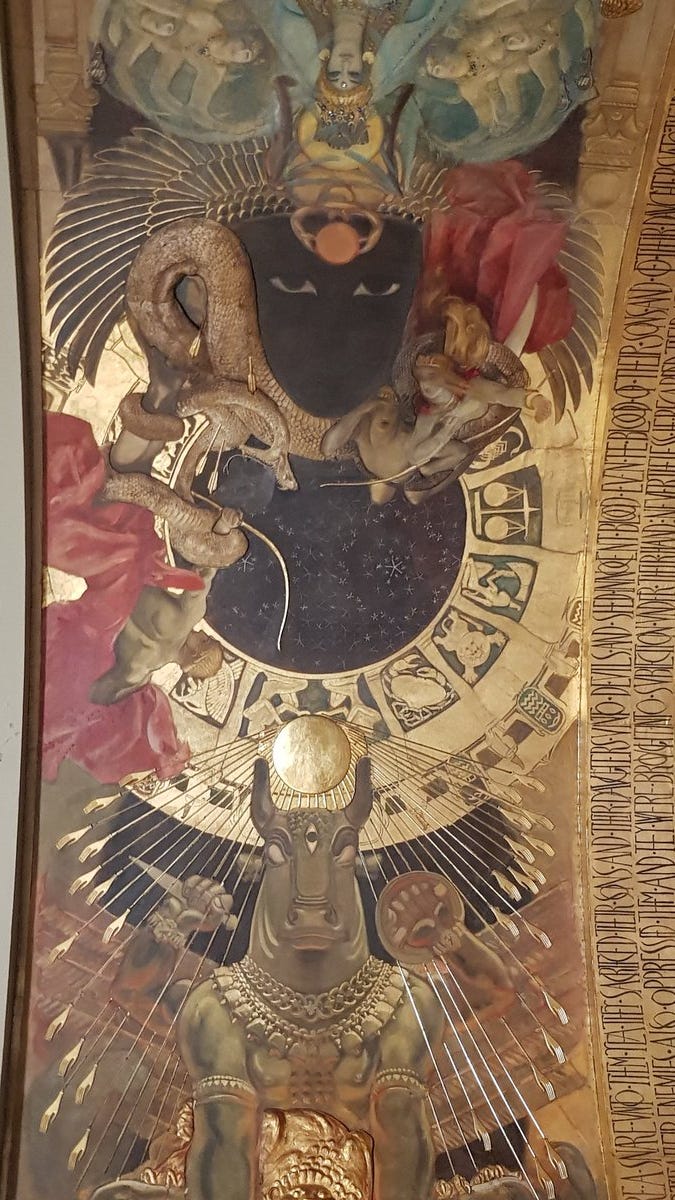
The main strength of the Orthodox dogma is that it envelops the entire world when articulated correctly, and this makes it highly contrarian. If one accepts a uniquely personal, historical revelation, then they accept that God is uniquely and ontologically personal, and this invalidates every other conception of the divine unless framed as incomplete spermatikos or logoi of the one true Logos. It invalidates every conception of God across traditions, most pointing to nonduality at their ontological apex, thus standing in opposition to all. In other words, from the standpoint of the Veda everything is contained, but the same is not true from the standpoint of Orthodoxy as regards the models of the world traditions, which Orthodoxy encapsulates through the Logos being uniquely Christologic. This does allow for a certain degree of truth to be found across the entire world, but critically it will always be incomplete unless fully participational in the one true light and Word incarnate, as a marriage between the heart of fallen man and the divine personhood of creation itself. It thus encompasses the world in full catholicism, which other forms of Christian doctrine are either less able to articulate or unable to altogether. That’s what the pretentious contrarian in me loves about the faith. In the spirit of great dialectics, it is both extremely contrarian at the high level and very popular at the low level (that of general Western traditional ethics, which I consider still popular for the time being). Perhaps one day this all encompassing and intoxicating marriage that unites the world will finally overcome me, but in its present condition in the West, until the modes of pure principle take greater precedence over the modes of world death and polemical conflict, it will be difficult for this to happen.
The main takeaway, and my solution for the time being, is that all of these problem areas in both systems have answers that come from both systems which adequately account for the deficiencies revealed in the first course of discernment of both systems. In Orthodoxy, the further one probes into the theology, the more answers there are for the questions I posed, as is the case for Advaita Vedanta. They are both closed loop, tight, coherent, complete, inexhaustible, and stem intellectually and intuitively from their own premises, and this is what a traditionalist would define as an orthodox tradition. Thus, the highest level technique is to contain, unresolved, each closed loop system into a broader one through symbology and esoterism, which is what traditionalist metaphysics aims to do. It does not do it in a secular, syncretic way either, but often through adoption of the Sufi12 doctrine, which they (Guenon, Schuon et al.) consider to be the most metaphysically universalized of the three Abrahamic salvational traditions (not accidentally, the chronologically final orthodox tradition to be revealed in the current cycle of the manvantara, which, again, is not to confuse adaptation13 with improvement). In this way, the doctrinal limitations of the Christine doctrine are accounted for, because in the age of dissolution the extraneous nature of these various details impede on strict salvation, which is of the utmost priority as long as falsehood is the prevailing characteristic of the world. In other words, where the Abrahamic traditions simplify and strip down ethics into their various exoteric safeguards, they succeed at retaining the living tradition better than does the ‘old rite’, which is vulnerable to misapplication and dilution due to the conditions of late humanity. When adopting this framework, ethics are essentially although unconfirmably retained in unresolved stasis. This process introduces epistemological uncertainty, but only to a slight degree, and it is within my personal risk tolerance as someone with a hippie persuasion, which is generally more comfortable with ambiguity and risktaking (read: degeneracy). And that is the hippie traditionalist tilt that this blog represents. To live on the edge a little.
The fallacy of infinite progress is often implicitly upheld. For instance, that we collectively think people couldn’t make detailed, lifelike, and anatomically correct art until the renaissance, rather than supposing that the abilities were always there but the mental shift towards humanism was not.
Devil’s advocate question just for fun: human sacrifice every once in a while, or mass shootings and mass overdoses every day? I won’t pretend to know the answer.
I suppose the major tradition with the fewest number of sus things going on might very well be Orthodoxy, but I can’t see the value in pragmatics, an entirely Western American invention, and I find statistics interesting but entirely horizontal and thus highly incomplete (which is ironic because I do it every day). Besides, on a statistical front, there are many problems. We don’t have data for all of the various denominations and subdemoninations of every tradition. For instance, Jains seem like they’re pretty infallible a lot of the time. For the data we do have, such as with Orthodoxy, of course four percent of the world has fewer scandals than do the remaining percentages. Of course an insular system with no overarching bureaucratic structure has less corruption. Of course the countries who have been insurged on by neoliberal or monarchical imperialism have more problems than the ones who haven’t. Of course any political power can use any tradition to do anything, like how Serbian nationalism used Orthodoxy in the Yugoslav Wars. There are limitless confounding variables (if you believe in that kind of thing). If one makes empirical claims they must be prepared to do so within the realm of empiricism, which is a tough realm to fight in indeed. It also benefits from isolation, which Americans are known to exhibit. Polemical arguments ignore the fact that Hindu and Muslim countries are empirically full of some of the most unselfish and radically hospitable people in the world, even if they do have a lot of problems. This marks the one and only time I will mention a need for data in my writing.
For example, the way I am reducing Hinduism to Advaita Vedanta as a universalist metaphysics, which weakens my argument because there are many irreducibly personal schools within the vast umbrella of Hinduism, as is the case in the vast umbrella of Buddhism, who would object to nonduality in the same way that Christian Orthodoxy does. But this is not addressed, in ROTF or in this post, because in both cases it would make the whole thing an order of magnitude more complex.
To be fair, it is virtually impossible to connect the theological minutiae of the written Vedas to the words they are actually saying without a really smart fucker like Guenon holding your hand the entire time. This is why the Sanatana Dharma is a living transmission that existed for millenia orally before it was ever written down, descended directly from the ṛṣis who were the primordial seers, capable of the intellectual intuition required to grasp what this stuff actually means.
I’m not necessarily arguing that Fr. Seraphim should not have written in this way because it is part of what gives Orthodoxy its high aesthetic, often mysterious and elusive Russians who want nothing to do with the rest of the world.
Tradition is another word the vast majority of the West does not understand the meaning of.
Not the least of which is the propensity of Americans, many of whom are raised Christian even if they denounce the faith, to enjoy vanquishing animals for no apparent reason except for entertainment, an activity that is relatively unprecedented and nihilistic to the extreme.
Is it a coincidence that Americans seem to only like dogs, the animal that is most personable (and loud), and care very little for say, chickens, which get mass genocided every day? I won’t pretend to have the answer.
In this instance the Christian existentialist, like Kierkegaard, has a lot of sway.
Recall the common line in the Vedas about one sincere utterance of the Name in the time of Kali being worth more than an eon of aescetic compunction in the golden age.
This brings to mind something I heard from a Sufi. Paraphrasing: would you rather know God through a poem or from a bunch of old dead guys arguing about what He is?
Esoterism points to the fact that the mystic, internalized counterpart of each orthodox exoteric tradition contains currents that approach or symbolically express nonduality; Kabbalah within Rabinic Judaism, Sufism within Sharīʿa, Mysticism within Thomistic Christianity, etc.
Baby’s first northeast winter